
Research chemical
CAS Number: 1212021-56-1
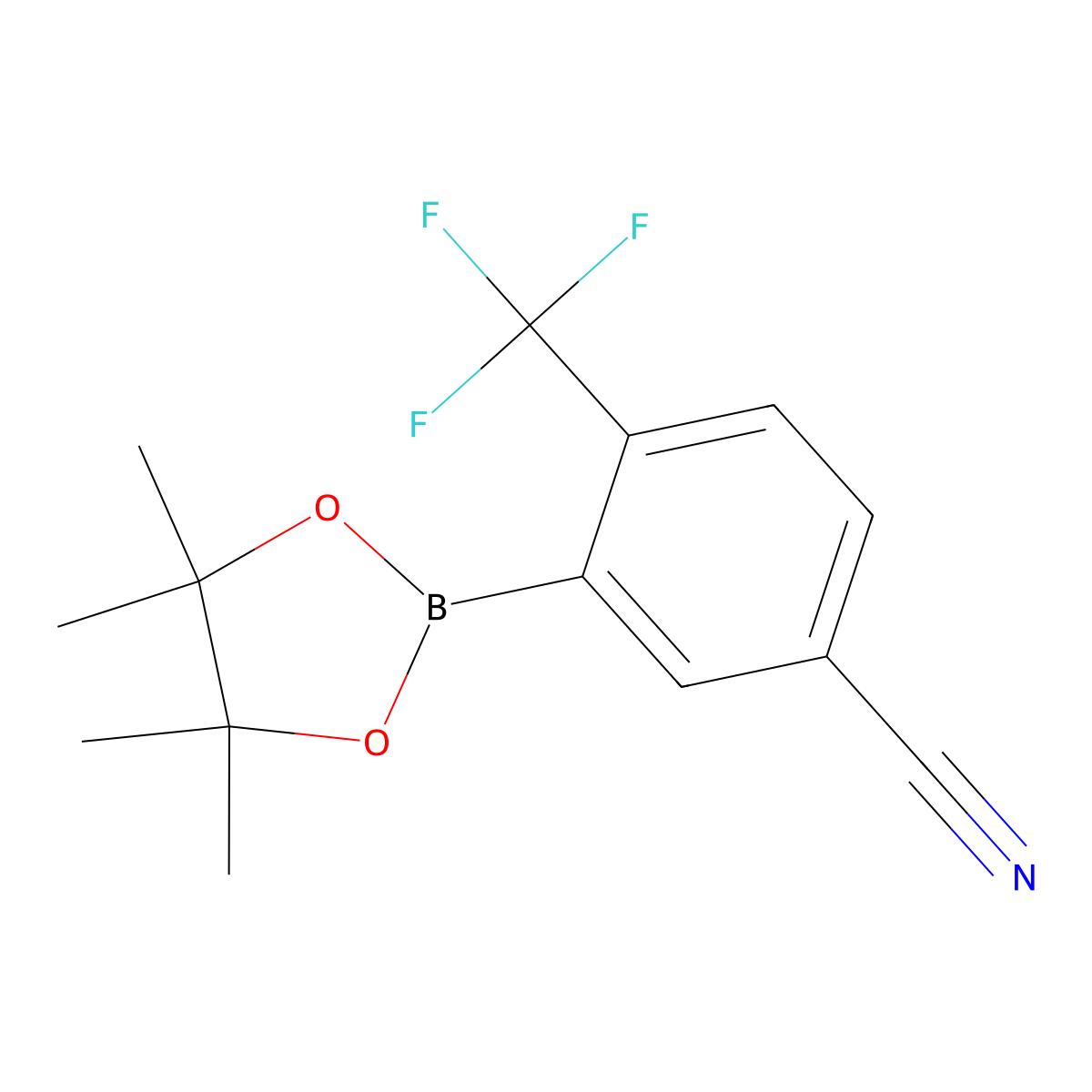
Product details
For laboratory research and professional procurement workflows.
PubChem CID
129959221
Exact Mass
297.114793
InChIKey
SESVSJGQAQACTL-UHFFFAOYSA-N
SMILES String
CC1(C)OB(c2cc(C#N)ccc2C(F)(F)F)OC1(C)C
Appearance
White crystalline powder
Physical State
Solid
Melting Point
130.0 °C
Boiling Point
400.0 °C
Density
1.4 g/cm³
Water Solubility
Slightly soluble
Flash Point
190.0 °C
Vapor Pressure
Estimated very low; unit not specified
Autoignition Temp
420.0 °C
Properties are provided as catalog reference data and may be confirmed through supplier documentation when required.
Heavy atom count
21
H-bond acceptors
3
H-bond donors
0
Rotatable bonds
1
Ring count
2
Aromatic rings
1
Topological polar surface area
42.25 Ų
Computed LogP
2.88
Structural features
A trifluoromethyl-substituted benzonitrile derivative featuring a pinacol boronic ester group, making it a valuable building block for Suzuki-Miyaura cross-coupling reactions in organic synthesis.
Sourcing context
Catalog reference for RFQ preparation, supplier confirmation, and research chemical sourcing review.
Research use context
This compound is primarily used as a versatile chemical building block in organic synthesis, especially for constructing complex molecules via Suzuki-Miyaura cross-coupling reactions.
Documentation needs
Handle with appropriate personal protective equipment (PPE) including gloves, eye protection, and a lab coat. Use in a well-ventilated area or fume hood to avoid inhalation. Avoid contact with skin and eyes.
Safety and handling reference content is available through documentation requests.
For supplier-issued SDS, request documentation before handling, storage, shipment, or procurement decisions.
Procurement notes
MolGraph uses public price and availability evidence as a starting point, then confirms current stock, quotation, COA/SDS, lot specification, lead time, and shipment documentation before final acceptance.
Use the quote panel for visible public options. Additional quantities or specifications can be reviewed by RFQ.
Purity, lot identity, and batch-specific documentation are confirmed before procurement decisions.
Supplier-issued COA and SDS can be requested before handling, storage, shipment, or procurement decisions.
Final quote depends on quantity, lead time, destination, and supplier confirmation.
3-(4,4,5,5-Tetramethyl-1,3,2-dioxaborolan-2-yl)-4-(trifluoromethyl)benzonitrile is listed as in-stock / available for research-use sourcing review. Final availability, lot specification, and lead time are confirmed by RFQ.
The page shows a public reference price in the quote panel. Submit an RFQ to confirm current price, quantity breaks, lead time, and destination-specific shipping requirements.
Yes. Supplier-issued COA and SDS can be requested during the RFQ workflow. Lot-specific documents depend on supplier and batch confirmation.
Fragment-like structure rule
Yes
Lead-like structure rule
Yes
Drug-like structure rule
Yes
Structure family
n heterocycle ligand
Precious metal motif
No
Transition metal motif
No
Phosphine ligand motif
No
N-heterocycle motif
Yes
Boronic acid motif
Yes
Computed structure descriptors generated from molecular structure. These are not experimental physical property values, supplier specifications, SDS data, or bioactivity claims.
HS Code: 293190
GHS pictograms

Compliance: standard-ruo
Shipment review: Required
Certificate of Analysis (COA): By request
Supplier Safety Data Sheet (SDS): By request
Purity and pack size confirmation: By request
Availability and lead time review: Confirmed by RFQ
Shipment documentation review: By request
For supplier-issued documentation by request, use the RFQ actions on this page.
DSL: pending; AICS: pending; ENCS: pending; ICSR: pending; TSCA: pending; IECSC: pending; INSQR: pending; REACH: pending; K-REACH: pending; SEA_Regulatory: pending
Registration values are catalog reference status cues and may require jurisdiction-specific review.
Non-public references are shown as text only and do not imply equivalence, availability, or shared use.